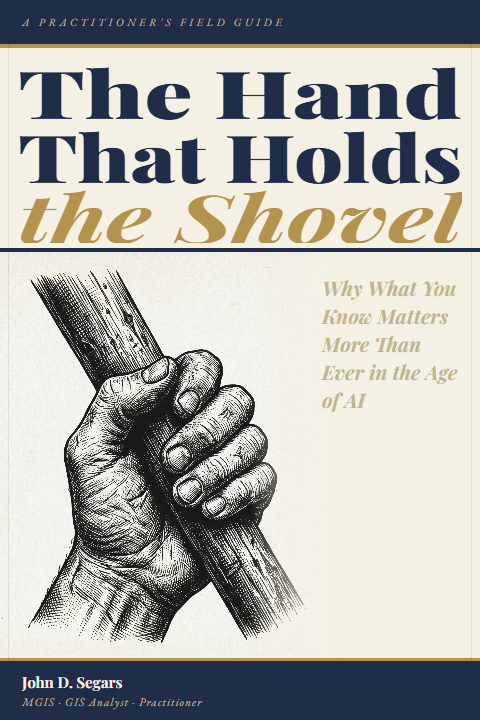
A practitioner's guide to the one thing AI cannot replace — the hard-won field knowledge that makes the difference between a tool that helps and a mistake that quietly becomes a decision.
I am not a programmer. I never have been. For most of my career that felt like a ceiling I couldn't quite reach past.
I'm a GIS analyst at a regional university in North Georgia. My job is managing the spatial data infrastructure that tells our institution where its buildings are, how its rooms are numbered, who occupies which space, and how all of that connects across five campuses — 3.6 million square feet of building space spread across 1,347 acres. One person. No team.
I've worked in GIS, network administration, systems management, and enterprise data integration for most of my career. I have an O'Reilly shelf that would embarrass most developers. I served in the Army. I've held a Penn State graduate degree in GIS. And still, when I needed to automate something in Python — when I hit a wall at ten o'clock at night with a script that wouldn't run and a deadline that wouldn't move — my options were grim. Wait three days for an Esri support response. Hope that someone on GeoNet had the exact same problem in 2019 and got a useful answer. Read through forum threads that were close but never quite right.
That isolation is real, and it has a cost. Not just in time — in what never gets built at all.
Then AI changed that. Not by replacing what I know. By meeting me exactly where I am.
The best analogy I've found is from construction. Before hydrovac excavation, if you needed to expose buried utilities you had two choices: hand dig with a shovel — slow, exhausting, and imprecise — or bring in a backhoe and risk destroying the very infrastructure you were trying to reach. Hydrovac isn't a perfect solution. It uses pressurized water and produces mud. It has its own complications. But it is faster, safer, and more efficient than what came before — and critically, it still requires a skilled operator who understands the process.
AI is the hydrovac. You're the operator. And the operator understands the process — because he knows what mistakes cost.
This guide is for anyone who wonders about AI, can't afford to ignore it any longer, or works with it every day and isn't sure they're doing it right.
Every field has a version of the same story: a capable professional, a confident AI output, and a quiet error that only someone with real experience would have caught. The machine didn't know what it didn't know. The practitioner did.
This is not a book about whether AI is good or bad. It's a book about what you bring to the table that no model can — and how to hold onto it as the pressure to defer grows stronger.
"You can rent a backhoe. You can buy one. What you cannot purchase is thirty years of knowing what the ground feels like when the blade hits something it shouldn't."
Drawing on three decades of hands-on practice in enterprise GIS, facilities management, and institutional data systems, John Segars makes the case for the irreplaceable value of domain expertise — and gives practitioners the language to defend it, use it, and pass it on.
Starting out in a world where AI tools are already assumed. Learn to build the expertise that makes you the check on the machine — not just its operator.
You already have what this book describes. This gives you the framework to recognize it, articulate it, and make sure it doesn't walk out the door when you do.
Building teams that will depend on AI outputs. Understand what institutional knowledge looks like, why it matters, and what you lose when it's gone.
Sign up to receive launch news, a free chapter, and occasional essays on expertise, AI, and the practitioners who keep things honest.
No spam. Unsubscribe anytime. Your address stays with me.